
GPU Hosting for Government Contractors: Compliance and Control
GPU hosting for government contractors is dedicated accelerated compute configured to meet the control, residency, isolation, and evidence obligations that federal data — particularly controlled unclassified information and sovereignty-sensitive workloads — imposes on the contractors that process it. The requirements exceed standard commercial hosting because the data and the contractual obligations around it carry federal consequences.
Government contractors evaluate GPU hosting when their AI workloads touch federal data, when their contracts impose specific control frameworks, or when sovereignty and supply-chain concerns dictate where and how the compute runs. The fit is determined by the contract's requirements, not by general commercial preferences.
Why Government Workloads Impose Stricter Requirements
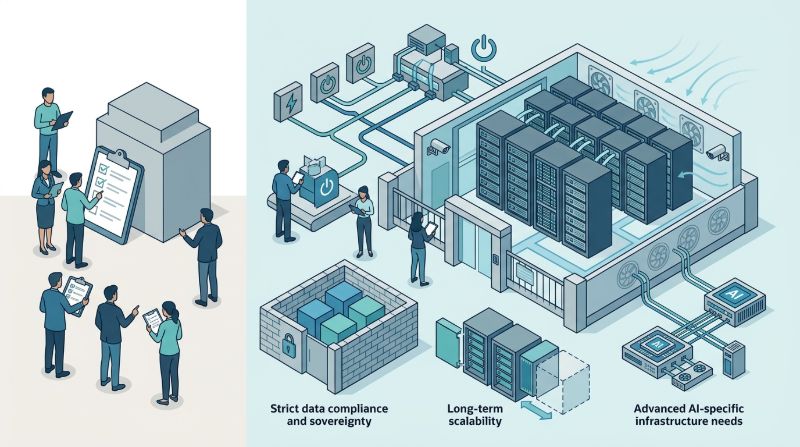
Federal data carries obligations that standard commercial infrastructure is not built to meet. Controlled unclassified information requires specific handling under frameworks that dictate access controls, residency, incident reporting, and supply-chain assurances. Sovereign-sensitive workloads may require that compute, data, and support stay within national boundaries and that certain entities cannot access them. The consequences of a mishandled federal dataset — contractual, legal, and reputational — exceed those of typical commercial data, which is why the control bar is higher.
This means a GPU hosting choice for government work is not just a performance or cost decision; it is a compliance decision evaluated against the contract's specific requirements. A provider that is excellent for commercial work may be unacceptable for federal work if its controls, residency, or supply chain do not meet the obligation.
Core Controls for Government Contractor GPU Hosting
Data Residency and Sovereignty
Federal workloads often require that data stay within defined national boundaries, with no cross-border movement for storage, backup, or support. For U.S. government work, this typically means compute and data in U.S. facilities operated under U.S. legal authority. A hosting model that cannot enforce and evidence this boundary is unacceptable for residency-bound workloads. Private AI infrastructure in a fixed U.S. zone is one way to make the boundary concrete.
Isolation for Controlled Data
Controlled unclassified information and other federal data categories require isolation from non-cleared environments and from other customers' workloads. Single-tenant or dedicated capacity removes the cross-tenant surface that shared infrastructure carries, which is why government work typically cannot run on shared multi-tenant GPU pools. The isolation requirement also extends to network, storage, and management planes, not just compute.
Personnel and Access Controls
Government work often requires that the people who can access the environment meet personnel suitability requirements — citizenship, background screening, or clearance appropriate to the data. A hosting model whose support staff do not meet these requirements, or whose access is not governed and auditable, cannot host the workload. The provider's access model must align with the contract's personnel controls.
Audit Evidence and Incident Reporting
Federal contracts require evidence that controls were in place and effective, and they require incident reporting within defined windows. A hosting model must produce the logging, access records, and control evidence an auditor or contracting officer will request, and it must support the incident-reporting obligations the contract imposes. Hosting that cannot evidence its controls cannot defend them when challenged.
Supply Chain Assurance
Government work increasingly requires supply-chain assurance — that the hardware, software, and services in the stack meet provenance and risk requirements. A hosting model whose supply chain the contractor cannot attest to is a risk under frameworks that address supply-chain threats. The provider should be able to describe its supply chain and how it meets the relevant assurance requirements.
What to Verify Before Hosting Government Workloads
Map the contract's specific requirements against the hosting model's controls: residency boundary, isolation model, personnel controls, audit evidence, incident reporting, and supply-chain assurance. Confirm that the provider can evidence each control and that its staff meet the personnel requirements. For U.S. work, confirm the compute and data are in U.S. facilities under U.S. authority. A provider that serves government contractors should answer these against the specific framework the contract invokes, not generically.
The verification should be framework-specific. A contract invoking CUI controls, FedRAMP-adjacent requirements, or agency-specific authority each demands different evidence, and a provider that claims broad compliance without addressing the specific framework is one whose claims are hard to rely on.
When Government Contractors Need Private or Dedicated GPU
Government work typically requires private or dedicated GPU rather than shared infrastructure, because the isolation and residency requirements are hard to meet on shared multi-tenant pools. The decision between owned hardware in a compliant facility and dedicated capacity from a provider who meets the controls follows the same logic as other regulated work: ownership trades capital and operations for maximum control, while dedicated capacity from a compliant provider transfers operations while retaining the control boundary. A managed model from a provider that meets government requirements can combine both.
FAQ
Does government GPU hosting require FedRAMP authorization?
It depends on the data and the contract. Some federal work requires FedRAMP-authorized cloud services; other work, particularly controlled unclassified information under specific frameworks, may be handled under different controls. The requirement is set by the contract and the data category, not by a general rule. Contractors should confirm the specific framework their work invokes before evaluating providers.
Can government contractors use commercial GPU cloud?
Sometimes, if the commercial cloud meets the contract's specific controls — residency, isolation, personnel, evidence, and supply chain. Often it cannot, because shared multi-tenant infrastructure does not meet the isolation or residency requirements federal data imposes. The question is whether a given commercial offering meets the specific framework, not whether commercial cloud is categorically acceptable.
What is the biggest compliance risk in GPU hosting for government work?
Assuming a provider's commercial controls meet federal requirements without verifying against the specific framework. A provider may have strong commercial security but fail a contract's residency, personnel, or evidence obligations. The risk is mitigated by mapping the contract's requirements to the provider's controls explicitly and confirming the provider can evidence each one.
Is dedicated capacity from a provider acceptable for government work?
It can be, if the provider meets the contract's controls and the capacity is configured to the required isolation and residency. Dedicated capacity from a compliant provider transfers operations while retaining the control boundary, which works for contractors that want the controls without self-operating. The provider must meet the specific framework the contract invokes, verified before commitment.
Summary
GPU hosting for government contractors must meet the control, residency, isolation, personnel, evidence, and supply-chain obligations that federal data imposes, evaluated against the contract's specific framework rather than general commercial standards. Private or dedicated GPU is typically required because shared infrastructure rarely meets federal isolation and residency needs. Government contractors can validate provider fit through an OneSource Cloud compliance review aligned to their contract requirements.
Related Articles
Recommended Reading
latest articles
-
GPU Hardware Spares and RMA: Fleet Logistics and Downtime Risk
-
AI Infrastructure Energy Reporting: What Enterprises Should Measure
-
Balanced Bandwidth per GPU: Sizing Cluster Networks for LLM Training
-
Model Flops Utilization: Why Training Efficiency Collapses and How to Fix It
-
How Much Spare GPU Capacity Inference Needs for Failover
-
Multi-Cloud GPU Management Overhead: The Hidden Cost of Split Estates
-
ITAR vs CUI for GPU Hosting: Controls That Actually Differ
-
RAG Corpus Refresh: Reindexing, Re-Embedding, and Freshness Operations
-
How to Cut LLM Latency Without Buying More GPUs
-
Batch vs Real-Time LLM Inference: When to Batch and What It Saves