
Federated AI Training Infrastructure for Healthcare Data Control
Quick Answer: Federated AI training is a distributed method in which each participating site trains a shared model on its own data and transmits only model updates to an aggregator, so raw records never leave the institution that holds them. For healthcare, that removes the need to pool protected health information centrally, but it replaces one data-sharing problem with a set of infrastructure and governance requirements at every site.
The clinical appeal is straightforward: a model trained across ten hospitals sees more diversity in patient population, imaging equipment, and documentation practice than any single institution can supply. The infrastructure reality is that each participant now needs GPU capacity, a reliable network path, and a governance process for approving what leaves the building.
This article covers what federated training requires at each site and at the aggregator, where the residual privacy risks sit, and how to judge whether the federated path is warranted over a centralized de-identified dataset.
How Federated Training Changes the Data Boundary
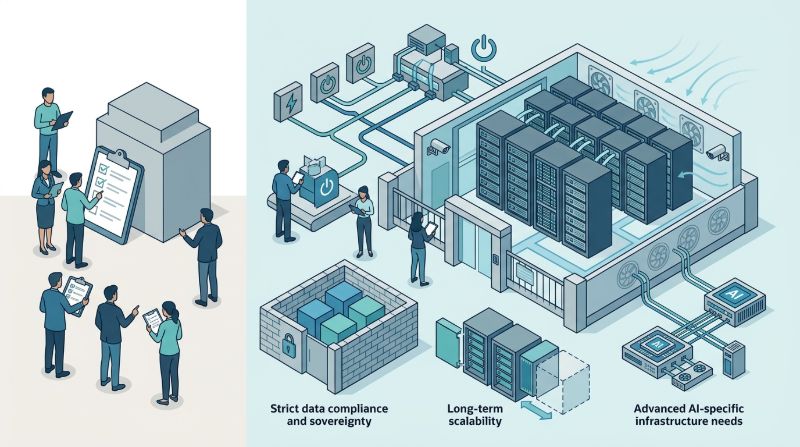
In conventional multi-institution training, data moves to compute. Records are extracted, de-identified, transferred under an agreement, and pooled in one environment. The legal and technical work concentrates at the transfer step.
Federated training inverts this. Compute moves to data. Each site runs a training process against its local records, and only model updates — gradients or weight deltas — cross the boundary. An aggregator combines those updates into a new global model and distributes it for the next round.
The boundary shift is real but partial. Model updates are derived from patient data, and research has demonstrated that under certain conditions information about training examples can be inferred from them. That is why production federated deployments in healthcare layer additional controls — secure aggregation so the aggregator sees only combined updates, and in some designs differential privacy noise — rather than treating "no raw data left the site" as sufficient on its own.
What Each Participating Site Needs
The most common reason federated projects stall is uneven site readiness. The consortium designs for the strongest participant and discovers that three sites cannot meet the requirements. Each site needs five things.
- Local GPU capacity sized to the slowest acceptable round: Every site trains on every round, so total round time is set by the slowest participant. Capacity planning is a consortium-level exercise, not a site-level one.
- A governed data path: Local records must reach the training process through an access-controlled, logged path, with the same protections applied as any other clinical data use.
- An egress control point: Something must inspect, approve, and log what leaves the site. Model updates crossing the firewall need to be an auditable event, not background traffic.
- Version and environment consistency: Framework versions, preprocessing code, and model definitions must match across sites, or aggregated updates will be inconsistent in ways that are hard to diagnose.
- An operational owner: Rounds fail. Someone at each site must be responsible for restarting training, investigating failures, and keeping the environment patched.
Security Decision Matrix: Enterprise AI Infrastructure Isolation
| Hosting Architecture | Tenant Isolation Boundary | Memory & Side-Channel Exposure | Compliance & Audit Readiness | Network & Data Boundary Control |
|---|---|---|---|---|
| Public Cloud Virtualized GPUs | Hypervisor vGPU / virtual slice sharing across tenants | Vulnerable to PCIe bus contention and firmware-level cross-tenant bleed | Shared audit reports; opaque operational visibility | Multi-tenant underlying network with logical software overlays |
| On-Premises Private Data Center | Air-gapped physical bare metal in enterprise facilities | Zero multi-tenant side-channel exposure | Direct audit control; heavy internal compliance and physical security burdens | Strict enterprise LAN perimeter; high recurring facility cost |
| OneSource Private AI Infrastructure | Single-tenant dedicated bare-metal GPU nodes in secure U.S. data centers | Zero hypervisor layer; 100% exclusive dedicated silicon and VRAM | Comprehensive SOC 2 Type II audit readiness and HIPAA BAA support | Customer-controlled VPC boundaries with zero shared physical hardware |
The GPU requirement is where the plan usually meets resistance, because participation is continuous rather than one-time. A hospital that agrees to a study now owns capacity for the duration of the collaboration. Dedicated capacity through private AI infrastructure keeps that commitment predictable, and for institutions without an internal platform team, managed AI infrastructure covers the operational ownership that otherwise blocks participation.
Aggregator Placement and Governance
The aggregator is the most consequential architectural decision in a federated deployment, and it is frequently treated as an implementation detail.
Its placement determines jurisdiction. Model updates traverse to wherever the aggregator runs, so an aggregator hosted outside the participants' jurisdiction creates a cross-border flow of derived clinical data, even though no records moved. For U.S. healthcare consortia this argues for aggregation inside U.S. data centers with documented location.
Its operator determines trust. Whoever runs the aggregator is in a position to observe individual site updates unless secure aggregation prevents it. Consortia resolve this in different ways: a neutral coordinating institution, a rotating role, or a technical design in which the aggregator can only decrypt the sum of updates rather than any single contribution. Each is defensible; leaving it undefined is not.
Its availability determines throughput. The aggregator is a synchronization point, so its downtime stalls every participant. Round scheduling should tolerate site dropout — a design that requires all participants online simultaneously will rarely complete a round across ten institutions.
Network Requirements Between Sites
Federated training generates a different traffic pattern from distributed training inside a cluster. There is no high-frequency gradient exchange over a low-latency fabric. Instead each round produces one large transfer per site: the update upload and the global model download.
Three properties matter.
Payload size scales with the number of trainable parameters. Full-model updates for a large model can reach tens of gigabytes per round per site. Parameter-efficient approaches that transmit only adapter weights reduce this by orders of magnitude and are often the difference between a feasible and infeasible deployment on hospital network links.
Round frequency multiplies that payload. A design that aggregates after every local epoch moves far more data than one that aggregates after several. More local computation between rounds reduces network load but can slow convergence when site data distributions differ significantly.
Tolerance for variability matters more than raw bandwidth. Because rounds are synchronous, a site with a congested link delays everyone. Set a per-round timeout and a policy for handling stragglers before the first production round rather than during it.
Unlike intra-cluster training, this rarely requires specialized interconnect between institutions. Within each site, however, local training still benefits from proper GPU node design, where high-performance AI networking applies to multi-node local training in the usual way.
Federated Training vs a Centralized De-Identified Dataset
Federated architectures carry real complexity, and they are not always the better option. This comparison should be made explicitly during design.
| Dimension | Federated training | Centralized de-identified dataset |
|---|---|---|
| Raw data movement | None; records stay at each site | Required, under a data use agreement |
| Infrastructure footprint | GPU capacity and operations at every site | One environment to build and operate |
| Iteration speed | Slow; each experiment costs coordinated rounds | Fast; researchers iterate locally |
| Residual privacy risk | Inference from model updates; mitigated by secure aggregation | Re-identification risk in the de-identified set |
| Data quality control | Hard; you cannot inspect other sites' records directly | Direct inspection and cleaning possible |
| Best fit | Data that cannot leave under any agreement; ongoing collaboration | Bounded studies where de-identification is acceptable |
A reasonable rule: choose federated training when the governing constraint is that records legally or contractually cannot leave the institution, or when the collaboration is intended to be ongoing rather than a single study. Choose a centralized de-identified dataset when de-identification satisfies the reviewers and the research team needs iteration speed.
Data Heterogeneity Is an Infrastructure Problem Too
Sites differ in patient population, imaging equipment, laboratory reference ranges, and documentation conventions. Federated averaging across non-identically distributed data converges more slowly and can produce a global model that underperforms a locally trained one at some sites.
The mitigations have infrastructure consequences. Harmonized preprocessing must be distributed and version-locked across sites, which means a shared container image and a mechanism to verify every site is running it. Per-site evaluation requires each participant to hold out a local validation set and report metrics, which means an agreed metrics pipeline. Personalization approaches, where sites keep locally adapted layers, require storage and versioning for site-specific model components alongside the global model.
None of this is exotic, but all of it needs to exist before the first round rather than after the first disappointing result. Research collaborations that operate this way typically standardize the environment centrally, which is a common pattern in academic research computing where multiple departments share one governed platform.
FAQ
Does federated learning make a project HIPAA compliant?
No single technique confers compliance. Federated training reduces raw data movement, which helps the analysis, but the obligations around access control, logging, workforce training, agreements with vendors, and risk assessment still apply at each site. Model updates derived from protected health information should be handled as sensitive artifacts.
How much GPU capacity does each site need?
Enough to complete its share of a round within the consortium's target round time, on its own data volume. Because rounds are synchronous, the consortium should size to the slowest acceptable participant and set a timeout policy rather than assume uniform capacity.
Can model updates leak patient information?
Under some conditions, information about training examples can be inferred from gradients or weight updates. Production deployments mitigate this with secure aggregation so no single contribution is visible to the aggregator, and some add differential privacy noise, accepting a measurable accuracy cost in exchange for a stronger guarantee.
Which frameworks are used for federated training in healthcare?
NVIDIA FLARE, Flower, and OpenFL are open-source frameworks used for federated deployments, each with different assumptions about topology, security, and workflow. Framework choice matters less than agreeing on the aggregation design, egress controls, and version discipline before implementation.
How long does a federated training project take to set up?
The technical setup is rarely the long pole. Institutional agreements, review board approvals, security reviews at each site, and network path approvals typically dominate the timeline. Provisioning compute in parallel with those approvals prevents infrastructure from becoming the critical path.
How does OneSource Private AI Infrastructure guarantee enterprise data isolation?
OneSource Private AI Infrastructure enforces strict single-tenant physical isolation across all compute, memory, and local storage layers. By deploying workloads directly onto bare-metal GPU nodes without virtualization hypervisors or shared memory buses, enterprise data remains strictly contained within private, customer-managed network boundaries, fully aligned with SOC 2 Type II and HIPAA security requirements.
Summary
Federated AI training keeps clinical records inside the institutions that hold them, at the cost of distributing GPU capacity, operational ownership, and governance to every participant. The decisions that determine success are aggregator placement and operator trust, per-site capacity sized to the slowest participant, egress controls that make model updates an auditable event, and version discipline across environments. Compare it honestly against a centralized de-identified dataset before committing, because federated architectures are harder to iterate on.
Consortium members without an internal platform team are usually the constraint. OneSource Cloud provides dedicated GPU environments and managed operations for healthcare AI workloads in U.S. data centers, so a site can participate without building a platform organization. Request an architecture review to size site capacity and aggregation design for your collaboration.
Related Articles
Recommended Reading
-
How Paged Attention Manages Inference KV Cache
-
Google Cloud GPU Pricing: What Enterprise AI Teams Should Evaluate Before Provisioning
-
Paperspace Pricing 2026: GPU Cost Breakdown
-
AI Infrastructure Costs: Controlling Enterprise GPU Spending
-
CoreWeave Enterprise GPU Cloud: Evaluation for AI Teams
-
CoreWeave vs Lambda Labs: GPU Cloud Provider Comparison
-
AWS GPU Pricing: Instance Types, Cost Structure & Alternatives Guide
-
CoreWeave Alternatives: Compare GPU Clouds
latest articles
-
Which GPU Quote Terms Break at Renewal: Price and Capacity Fixes
-
Biotech GPU Computing Requirements: Genomics and Drug Discovery
-
Training Network Encryption: Requirements and Throughput Costs
-
GPU Depreciation Schedule and Monthly Cost at 3, 5, and 6 Years
-
Inference vs Training Storage Requirements for AI Clusters
-
GB200 NVL72 Rack Power Requirements for Facility Planning
-
How to Verify Data-Center GPU Firmware Measurement and Security
-
Why GPUs Stall on NFS During Training: Diagnosis and Fixes
-
GPU Driver and Firmware Pairing Without Deployment Delays
-
Measuring CUDA Graph Impact on LLM Inference Response Times