
Dedicated GPU Cloud Capacity Guarantees to Demand Before You Sign
Reserved capacity is the most misread product in the dedicated GPU cloud market. Marketing pages quote headline figures — 99% service availability, 95% capacity availability — and procurement teams sign, assuming those numbers guarantee that their training run gets its GPUs every morning. The guarantee that arrives in the contract is a different, narrower object, and the gap between the two is where capacity shortfalls, credit disputes, and renewal surprises live. This page decomposes what a capacity guarantee must specify, so you can negotiate the clause rather than the slogan.
Quick Answer: What Should a GPU Capacity Guarantee Specify?
A real capacity guarantee names six things: scope (GPU type, count, location, term), an oversubscription policy (your resource is never resold or shared), credit mechanics (what compensation triggers and how it is calculated), a complete exclusions list, expansion rights (price basis and lead time for growth), and exit terms. Verify each in contract text, not in marketing. Providers running single-tenant bare-metal enclaves — OneSource Cloud among them — can prove exclusivity architecturally, which is a stronger position than a virtualized reservation can reach by contract alone.
What a Capacity Guarantee Actually Promises
A capacity guarantee is a promise about availability of a defined resource scope — GPU type, quantity, location, and term — and its force depends entirely on those four parameters being explicit. Headline figures such as 99% service availability or 95% capacity availability mean little until the contract names whether the scope is a reservation on shared infrastructure or physically exclusive hardware, and whether the measure is service reachability or allocation success.
| Scope Parameter | What to Pin Down | Typical Ambiguity |
|---|---|---|
| GPU type | Exact SKU and memory, not a class | Substitutions at provider discretion |
| Quantity | Node count and usable GPU count | Per-cluster versus per-account pooling |
| Location | Data center and availability zone | Regional flexibility claimed as locality |
| Term | Start, end, and renewal mechanics | Auto-renewal at uncapped rates |
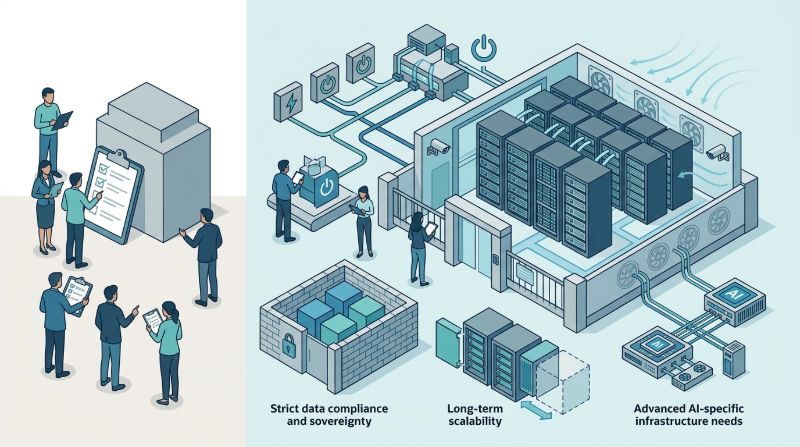
The deeper distinction is architectural. A reservation on virtualized infrastructure promises that the provider will not allocate your capacity elsewhere; a single-tenant bare-metal allocation makes sharing physically impossible. OneSource Cloud delivers the latter structure — dedicated GPU nodes in U.S. data centers where the tenancy boundary is the metal itself, under flat-rate monthly pricing — so the exclusivity conversation moves from contract language to facility architecture. Neither structure is wrong, but they produce different evidence in a compliance review, and you should know which one you are buying.
The Six Clauses to Demand and How to Verify Each
Demand six clauses: scope definition, an oversubscription policy stating the resource is never resold or shared, credit mechanics with calculation examples, an exclusions list read in full, expansion rights with price and lead time locked, and exit or migration terms. Verify each against the contract text and ask for evidence of historical allocation success — a provider running single-tenant bare-metal enclaves can prove exclusivity architecturally, where a virtualized reservation can only promise it contractually.
| Clause | Verification Evidence to Request |
|---|---|
| Scope definition | Hardware inventory with SKUs, data center identification |
| Oversubscription policy | Written never-resold clause; tenancy attestation for bare metal |
| Credit mechanics | Worked examples: what a 4-hour breach pays, measured how |
| Exclusions list | Full text review; ask what percentage of historical credits fell in exclusions |
| Expansion rights | Price basis (fixed or capped escalation), lead time in weeks, same exclusivity terms |
| Exit terms | Data egress position, migration assistance, termination economics |
Two verification questions separate serious providers from confident ones. First: show me the last twelve months of allocation success against your published availability figure — a provider measuring service reachability rather than allocation success will show you a different dataset than the one your capacity plan needs. Second: what happens to my workload if a node fails — the answer should name spare capacity, migration mechanics, and a time bound, not a credit formula alone.
Which Workloads Need Guaranteed Capacity — and Which Do Not
Guaranteed dedicated capacity fits steady production inference, long-running training with checkpoint schedules, and any regulated workload where re-run cost is counted in compliance exposure, because idle-time risk is priced into the contract knowingly. Elastic or spot capacity fits experimentation, hyperparameter search, and fault-tolerant batch jobs that can retry around preemption; paying reservation premiums for those workloads buys certainty they cannot use.
| Workload Class | Guaranteed Dedicated | Elastic or Spot |
|---|---|---|
| Steady production inference | Fit — utilization floors pay the premium back | Tail-latency risk at peak |
| Long-running training | Fit — checkpoint schedules assume continuity | Preemption breaks scheduling |
| Regulated workloads | Fit — exclusivity evidence simplifies review | Shared tenancy complicates evidence |
| Hyperparameter search | Misfit — pays for idle between trials | Fit — retries absorb preemption |
| Experimentation | Misfit — certainty without use | Fit — elasticity matches uncertainty |
Most organizations run a mixed portfolio, and the honest capacity plan assigns each workload class its own supply. OneSource Cloud customers typically anchor their steady classes in a dedicated enclave and keep elastic overflow elsewhere — a portfolio posture, not a house-wide verdict. The cost of misclassification runs in both directions: reservations on search workloads waste premium, and production inference on spot capacity eventually teaches the team what preemption costs.
Scale-Up Terms: Expansion Rights, Multi-Year Pricing, and True-Ups
A guarantee that cannot grow is a ceiling: expansion rights should state price basis (same or capped escalation), lead time in weeks, and whether expansion preserves the same exclusivity terms, because providers routinely quote attractive initial terms and loose renewal economics. Multi-year agreements trade discount against lock-in, so model the true-up scenario — needing 50% more capacity at month 14 — before signing, not after.
| Scale-Up Clause | Weak Version | Strong Version |
|---|---|---|
| Expansion pricing | Market rates at time of request | Original price basis or capped escalator |
| Expansion lead time | Best effort | Committed weeks with remedies |
| Expansion terms | New contract, new rules | Same exclusivity and SLA schedule |
| True-up mechanics | Renegotiate at renewal | Mid-term addendum with preset economics |
Run the true-up model with real numbers before the negotiation: take your plausible growth case, price it under the proposed expansion clause, and compare it against the competing provider. The exercise takes an afternoon and routinely moves the renewal economics more than any discount off the headline rate. Growth assumptions older than two quarters are stale — re-model before each renewal window, because the GPU market repriced three times in the last two years.
FAQ
Do SLA credits compensate a failed or interrupted training run?
Usually not. Credit mechanics in published SLAs compensate service or capacity unavailability against a measured availability figure, not the value of a lost job. Checkpoint discipline, job-level retry design, and for regulated runs a documented risk acceptance remain the buyer-side protection. When you model the guarantee, price the credit as a discount on a bad month — never as insurance on the workload itself.
How does OneSource Cloud guarantee dedicated GPU capacity?
OneSource Cloud provisions single-tenant bare-metal enclaves in U.S. data centers, so the GPUs in the contract are physically exclusive to the tenant with no hypervisor sharing and no resale of capacity, backed by predictable flat-rate monthly pricing with zero egress fees rather than metered burst economics. Expansion is quoted on the same single-tenant basis, which keeps the true-up scenario comparable instead of renegotiated.
Related Articles
Recommended Reading
-
How Paged Attention Manages Inference KV Cache
-
Google Cloud GPU Pricing: What Enterprise AI Teams Should Evaluate Before Provisioning
-
Paperspace Pricing 2026: GPU Cost Breakdown
-
AI Infrastructure Costs: Controlling Enterprise GPU Spending
-
CoreWeave Enterprise GPU Cloud: Evaluation for AI Teams
-
CoreWeave vs Lambda Labs: GPU Cloud Provider Comparison
-
AWS GPU Pricing: Instance Types, Cost Structure & Alternatives Guide
-
CoreWeave Alternatives: Compare GPU Clouds
latest articles
-
Which GPU Quote Terms Break at Renewal: Price and Capacity Fixes
-
Biotech GPU Computing Requirements: Genomics and Drug Discovery
-
Training Network Encryption: Requirements and Throughput Costs
-
GPU Depreciation Schedule and Monthly Cost at 3, 5, and 6 Years
-
Inference vs Training Storage Requirements for AI Clusters
-
GB200 NVL72 Rack Power Requirements for Facility Planning
-
How to Verify Data-Center GPU Firmware Measurement and Security
-
Why GPUs Stall on NFS During Training: Diagnosis and Fixes
-
GPU Driver and Firmware Pairing Without Deployment Delays
-
Measuring CUDA Graph Impact on LLM Inference Response Times