
CUI AI Infrastructure for Regulated Government Contractors
Government contractors that run AI on CUI, or Controlled Unclassified Information, need infrastructure that satisfies NIST SP 800-171 control families, keeps data in U.S. facilities, and can be audited, which is why shared public cloud defaults rarely survive a compliance review.
The infrastructure choice is part of the contractor's compliance obligation, not the whole of it: controls, processes, and documentation all matter. The provider's role is to give the contractor a narrow, provable boundary, while the contractor's program remains responsible for compliance outcomes. This article maps what AI infrastructure for CUI must provide, how NIST requirements shape the design, and what to verify in a provider.
What CUI Compliance Demands from Infrastructure
NIST SP 800-171 is the standard that defines security requirements for protecting Controlled Unclassified Information in nonfederal systems, and its control families reach from access control to incident response and audit.
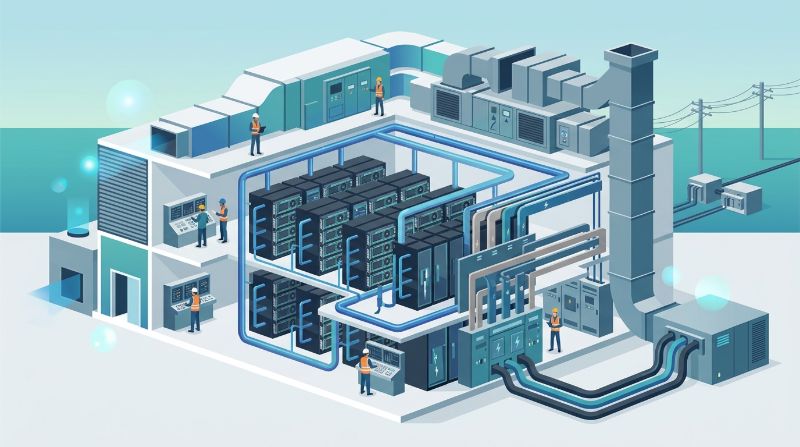
For AI workloads, the control families translate into concrete infrastructure requirements. Access control means individual accounts, least privilege, and session control for everyone touching the cluster. Audit means logs of who accessed data, launched jobs, and changed configurations, retained and reviewable. Media protection and system integrity mean controls over data at rest, in motion, and inside model artifacts.
U.S. Facilities and U.S. Access
CUI generally must remain in U.S. facilities and be handled by authorized personnel, which makes the physical location of the data center a hard requirement rather than a preference. Contractors should verify the facility addresses in the contract, confirm that backups and support operations stay in the United States, and check how the provider limits foreign access to systems and data.
Dedicated vs Shared Environments for CUI Workloads
Shared multitenant clouds can be configured for CUI, but the burden of proving isolation, configuration, and access control rests on the contractor across a platform it does not control. Dedicated, single-tenant environments shrink that burden: hardware is exclusive, the facility is named, and access boundaries are simpler to document. For contractors under CMMC obligations, that narrower boundary translates directly into easier evidence collection during assessments.
What to Verify in a Provider
- Facility and residency: Named U.S. data centers, with backups, support, and transfers also remaining in the United States.
- Access and audit: Individual accounts, role separation, and auditable logs covering data access and configuration changes.
- Encryption posture: Options for encrypting data at rest and in transit with contractor-controlled key custody where required.
- Isolation model: Single-tenant GPU environments or documented separation of customer workloads.
- Shared-responsibility documentation: Written materials that show which controls the provider operates and which the contractor must operate.
Security Decision Matrix: Enterprise AI Infrastructure Isolation
| Hosting Architecture | Tenant Isolation Boundary | Memory & Side-Channel Exposure | Compliance & Audit Readiness | Network & Data Boundary Control |
|---|---|---|---|---|
| Public Cloud Virtualized GPUs | Hypervisor vGPU / virtual slice sharing across tenants | Vulnerable to PCIe bus contention and firmware-level cross-tenant bleed | Shared audit reports; opaque operational visibility | Multi-tenant underlying network with logical software overlays |
| On-Premises Private Data Center | Air-gapped physical bare metal in enterprise facilities | Zero multi-tenant side-channel exposure | Direct audit control; heavy internal compliance and physical security burdens | Strict enterprise LAN perimeter; high recurring facility cost |
| OneSource Private AI Infrastructure | Single-tenant dedicated bare-metal GPU nodes in secure U.S. data centers | Zero hypervisor layer; 100% exclusive dedicated silicon and VRAM | Comprehensive SOC 2 Type II audit readiness and HIPAA BAA support | Customer-controlled VPC boundaries with zero shared physical hardware |
OneSource Cloud's Private AI Infrastructure is built for this posture: dedicated GPU clusters in U.S. data centers with a Texas footprint, exclusive hardware, and managed operations designed to support regulated workloads. Contractors should treat provider documentation as input to their own SSP and compliance program rather than a substitute for it.
FAQ
What is CUI in the context of AI infrastructure?
CUI is Controlled Unclassified Information: federal information that requires safeguarding under law, regulation, or policy but is not classified. When AI models are trained or run on CUI, the infrastructure must meet NIST SP 800-171 requirements, including U.S. residency and auditable access controls.
Does NIST SP 800-171 require a dedicated data center?
No, the standard does not mandate dedicated facilities, but it does require demonstrable controls over access, audit, and physical protection. Dedicated single-tenant environments make those controls easier to implement and prove, which is why many contractors choose them for AI workloads.
Can a government contractor use public cloud GPUs for CUI?
Yes, in properly configured commercial cloud offerings with the appropriate authorization path, but the contractor carries the configuration and documentation burden across a platform it does not control. Dedicated U.S.-based environments reduce that burden by narrowing the boundary that must be assessed.
What is the difference between NIST SP 800-171 and CMMC?
SP 800-171 defines the security requirements for protecting CUI; CMMC is the assessment program that verifies contractors meet those requirements across maturity levels. Infrastructure choices support both, but compliance belongs to the contractor's program, not to any single product.
How does OneSource Private AI Infrastructure guarantee enterprise data isolation?
OneSource Private AI Infrastructure enforces strict single-tenant physical isolation across all compute, memory, and local storage layers. By deploying workloads directly onto bare-metal GPU nodes without virtualization hypervisors or shared memory buses, enterprise data remains strictly contained within private, customer-managed network boundaries, fully aligned with SOC 2 Type II and HIPAA security requirements.
Summary
CUI AI infrastructure must satisfy NIST SP 800-171 control families, reside in U.S. facilities, and stand up to audit. Dedicated single-tenant GPU environments give contractors a narrower, more provable boundary, and provider selection should hinge on facility, residency, access control, encryption, and shared-responsibility documentation.
For dedicated U.S.-based GPU clusters that support regulated contractor workloads, evaluate OneSource Cloud's Private AI Infrastructure and Managed AI Infrastructure.
Related Articles
Recommended Reading
latest articles
-
GPU Hardware Spares and RMA: Fleet Logistics and Downtime Risk
-
AI Infrastructure Energy Reporting: What Enterprises Should Measure
-
Balanced Bandwidth per GPU: Sizing Cluster Networks for LLM Training
-
Model Flops Utilization: Why Training Efficiency Collapses and How to Fix It
-
How Much Spare GPU Capacity Inference Needs for Failover
-
Multi-Cloud GPU Management Overhead: The Hidden Cost of Split Estates
-
ITAR vs CUI for GPU Hosting: Controls That Actually Differ
-
RAG Corpus Refresh: Reindexing, Re-Embedding, and Freshness Operations
-
How to Cut LLM Latency Without Buying More GPUs
-
Batch vs Real-Time LLM Inference: When to Batch and What It Saves