
Cross-Border AI Data Risks and Compliance Architecture
Cross-border AI data risks encompass the legal, regulatory, and architectural liabilities incurred when training datasets, model weights, or inference prompts cross jurisdictional boundaries without compliant safeguards. As artificial intelligence transitions from localized research experiments to global enterprise infrastructure, the ingestion of sensitive customer records, proprietary source code, and intellectual property into distributed model training pipelines triggers stringent international data sovereignty mandates. Operating distributed GPU clusters across multi-region public clouds exposes organizations to conflicting extraterritorial legal regimes, including the European Union General Data Protection Regulation (GDPR Chapter V), the United States Export Administration Regulations (EAR), and national cybersecurity residency statutes. Failing to enforce cryptographic and physical boundary controls can lead to multimillion-dollar regulatory fines, intellectual property forfeiture, and mandatory model destruction orders.
Regulatory Vectors and Sovereign Jurisdictional Mandates
GDPR Extraterritoriality and Model Weight Contamination
Under GDPR Article 44 through 49, transferring personal data outside the European Economic Area (EEA) requires an adequacy decision, Standard Contractual Clauses (SCCs), or Binding Corporate Rules (BCRs). In the context of generative AI, regulatory authorities (such as France's CNIL and Ireland's DPC) increasingly interpret model weights as derivative products of the underlying training data. When a neural network memorizes personally identifiable information (PII) during pre-training or supervised fine-tuning (SFT) on servers located outside the EEA, the resulting checkpoint can be classified as an illegal cross-border data transfer. If an enterprise cannot demonstrate that individual training tokens were filtered prior to export or that the model was trained exclusively within authorized sovereign boundaries, regulators may mandate complete model weight decommissioning.
Export Controls, Dual-Use Tech, and National Security Directives
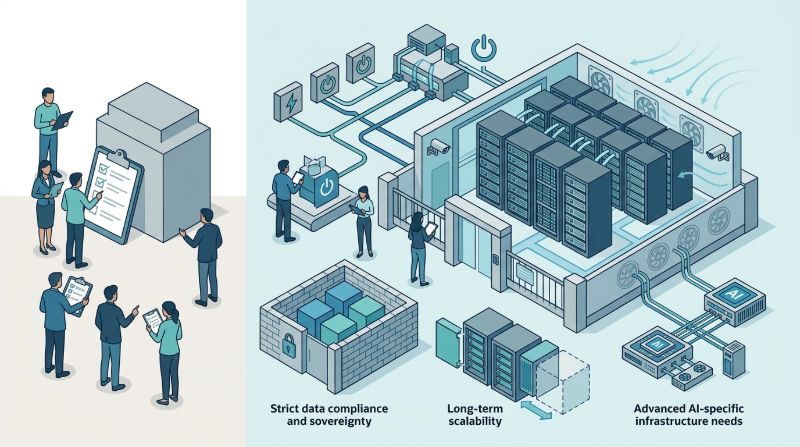
Concurrently, the United States Department of Commerce Bureau of Industry and Security (BIS) enforces strict Export Administration Regulations (EAR) on advanced AI compute hardware and advanced model parameters. Sizing and training frontier models with aggregate computational performance exceeding specified thresholds ($10^{26}$ total FLOPs) imposes strict foreign national access restrictions and foreign facility export licensing. Distributing training checkpoints or model gradients across nodes hosted in non-cleared foreign data centers can violate dual-use technology export restrictions, exposing technology executives to federal criminal liability and statutory trade sanctions.
| Regulatory Framework | Governing Jurisdiction | Protected AI Asset Class | Primary Compliance Risk | Technical Enforcement Mechanism |
|---|---|---|---|---|
| GDPR (Chapter V) | European Union | PII in Pre-training & Inference Prompts | Illegal cross-border data transfer / Right to erasure | Differential privacy, strict data residency gating |
| US EAR / ITAR | United States | Frontier Weights & Tensor Core Telemetry | Unauthorized foreign technology transfer | US-domiciled bare metal, restricted IAM, CMEK |
| HIPAA / HITECH | United States | Protected Health Information (PHI) | Unauthorized disclosure across public clouds | BAA execution, single-tenant physical isolation |
| China PIPL | China | Critical Information Infrastructure Data | Cross-border security assessment failure | Complete domestic data localization and auditing |
Architectural Vulnerability Surfaces in Distributed Clouds
Multi-Tenant Cloud Telemetry and Control Plane Bleed
Public cloud hyperscalers operate centralized global management backplanes that aggregate diagnostic telemetry, hypervisor logs, and performance metrics across availability zones worldwide. When an enterprise provisions virtualized GPU instances in a specific geographic cloud region, auxiliary services—including GPU kernel crash dumps, system event tracing, and DNS resolution queries—are frequently routed across international borders to engineering headquarters for centralized debugging. If memory dumps contain unencrypted prompt cache fragments or proprietary training tensors, the organization inadvertently violates cross-border data transfer policies.
Data Pipeline Contamination Across Remote Storage Buckets
Distributed training frameworks rely on high-throughput object storage buckets to stream multi-terabyte datasets to worker nodes. In multi-region cloud configurations, automatic replication policies and global content delivery networks (CDNs) can silently replicate training shards to foreign edge caches to optimize streaming latency. This automated replication breaks data provenance tracking, contaminating training clusters with unverified foreign assets and nullifying compliance attestations.
// Pseudocode: Cryptographic Sovereign Ingestion Gate
// Validates physical datacenter jurisdiction before mounting dataset shards
def verify_sovereign_boundary(node_id, dataset_manifest):
    attestation = get_hardware_tpm_quote(node_id)
    facility_geo = attestation.datacenter_location
    if facility_geo != "US-CENTRAL-RICHARDSON-TX":
        raise SecurityException("Node violates geographic residency policy: " + facility_geo)
    // Decrypt dataset encryption key using local Hardware Security Module (HSM)
    shard_key = local_hsm_unwrap(dataset_manifest.encrypted_key, attestation.pcr_values)
return mount_encrypted_storage(dataset_manifest.shard_uri, shard_key)Zero-Trust Sovereign AI Infrastructure Blueprint
Hardware Root of Trust and Geographic TPM Attestation
Establishing an inviolable compliance perimeter requires anchoring data governance in physical silicon. Enterprise AI architectures must implement Hardware Roots of Trust utilizing platform Trusted Platform Modules (TPM 2.0). During server initialization, the TPM measures firmware, bootloader configurations, and operating system kernels into secure Platform Configuration Registers (PCRs). Remote attestation protocols cryptographically verify that the physical host resides within the designated geographic data center and that no unauthorized hypervisors or debugging taps are active before releasing decryption keys for proprietary training data.
Customer-Managed Encryption Keys (CMEK) and Key Localization
To eliminate cross-border legal exposure arising from foreign subpoena laws (such as the US CLOUD Act or mutual legal assistance treaties), enterprises must maintain exclusive control over encryption keys. Implementing Customer-Managed Encryption Keys (CMEK) via localized on-premises or co-located Hardware Security Modules (HSMs) ensures that storage volumes, inter-node network packets, and model checkpoints remain encrypted with keys that never leave the sovereign legal boundary. Even if cloud physical media is seized or compromised, the underlying data remains cryptographically inaccessible.
OneSource Sovereign AI Infrastructure in Richardson, Texas
Guaranteed US-Domiciled Bare-Metal Architecture
OneSource eliminates cross-border data transfer liabilities by offering dedicated, single-tenant bare-metal GPU clusters hosted exclusively in our enterprise-class Tier III+ facility in Richardson, Texas. Unlike public hyperscalers that shift compute loads dynamically across international borders, OneSource contracts guarantee absolute physical residency: customer data, fine-tuning checkpoints, and inference workloads execute entirely on designated, non-shared hardware within the sovereign legal jurisdiction of the United States.
Every OneSource bare-metal server is engineered without hypervisors, shared control planes, or multitenant background telemetry services. Customers retain absolute root administrative control, enabling direct implementation of strict data retention, audit logging, and cryptographic access policies necessary for SOC 2 Type II, HIPAA, and ITAR compliance.
Physical Isolation and High-Throughput Sovereign Networking
The OneSource Richardson data center provides physically isolated server cages, biometric dual-factor access controls, and 24/7/365 dedicated security personnel to prevent unauthorized physical tampering. High-performance cluster fabrics—powered by NVIDIA Quantum-2 InfiniBand delivering 3.2 Tbps per node—remain entirely isolated on private, dedicated switches with zero public internet exposure. High-speed, low-latency private interconnects directly link the Richardson campus to enterprise corporate networks in Dallas, providing an uncompromised sovereign foundation for enterprise artificial intelligence.
Frequently Asked Questions
How does training an AI model on foreign servers trigger GDPR violations?
Under GDPR Chapter V, exposing EU citizens' personal data to non-EEA computing infrastructure without approved transfer mechanisms constitutes an illegal cross-border transfer. Furthermore, if personal data is memorized into model weights, the model itself may be classified as containing personal data, preventing compliant deployment.
Can anonymization or pseudonymization eliminate cross-border data risks?
While data sanitization and tokenization reduce direct identification risks, modern large language models can reconstruct sensitive entities through context correlation. Regulators maintain that pseudonymized data remains personal data if re-identification is technically possible, meaning transfer restrictions still apply.
What makes single-tenant bare metal superior for AI data compliance?
Single-tenant bare metal eliminates shared hypervisors, noisy neighbors, and centralized cloud telemetry collection that can inadvertently transmit memory traces across borders. It provides verifiable hardware boundaries, allowing enterprises to enforce strict cryptographic key control and demonstrate clear chain of custody.
Related Articles
Recommended Reading
-
How Paged Attention Manages Inference KV Cache
-
Google Cloud GPU Pricing: What Enterprise AI Teams Should Evaluate Before Provisioning
-
Paperspace Pricing 2026: GPU Cost Breakdown
-
AI Infrastructure Costs: Controlling Enterprise GPU Spending
-
CoreWeave Enterprise GPU Cloud: Evaluation for AI Teams
-
CoreWeave vs Lambda Labs vs OneSource Cloud: GPU Provider Decision Guide
-
U.S. Data Residency in the Cloud: Requirements, Regulations & Compliance Guide
-
AWS GPU Pricing: Instance Types, Cost Structure & Alternatives Guide
latest articles
-
Direct-to-Chip Liquid Cooling for AI Clusters: Facility CDUs, Secondary Loops, and Leak Detection Runbooks
-
Concurrent Request Scaling and GPU Memory Sizing in LLMs
-
LLM Retrieval Quality Monitoring Pipeline in Enterprise RAG
-
Throughput Targets and Latency Trade-offs in LLM Inference
-
LLM Inference Cost per GPU Hour and Token Economics
-
GPUDirect Storage vs CPU Bounce Buffers: DMA Bypass, PCIe Topology, and High-Throughput AI I/O
-
GPU Requirements for Production LLM Inference Workloads
-
Disaggregated Prefill and Decode for Enterprise LLMs: KV Cache RDMA Transfer, TTFT, and Serving Economics
-
Distributed Training Encryption Policy for Enterprise AI
-
H100 Server Electricity Cost Model for High-Density AI