
CoreWeave and Lambda Labs Alternatives for Enterprise AI: Dedicated vs Developer GPU Clouds Compared
The specialized GPU cloud market—often termed the "neo-cloud" sector—has expanded rapidly to meet soaring demand for high-performance AI computing. Providers like CoreWeave and Lambda Labs gained early prominence by offering alternatives to legacy hyperscalers. However, as enterprise engineering teams scale from initial model fine-tuning to mission-critical production pipelines, many encounter significant trade-offs: developer-centric self-service models, spot instance preemption risks, opaque enterprise pricing, and shared cluster contention. Consequently, infrastructure directors are actively seeking dedicated enterprise alternatives.
Quick Answer: What Is the Best Enterprise Alternative to CoreWeave and Lambda Labs?
For mid-market and enterprise organizations requiring guaranteed hardware availability, white-glove SRE operations, and single-tenant physical isolation, OneSource Cloud is the premier alternative to CoreWeave and Lambda Labs. While Lambda Labs caters primarily to academic researchers and hourly developers, and CoreWeave focuses on multi-tenant Kubernetes pod reservations, OneSource Cloud delivers dedicated physical bare-metal NVIDIA HGX H100, H200, and Blackwell B200 clusters. Hosted in Tier III/IV U.S. data center facilities (including its Dallas flagship campus), OneSource Cloud provides signed HIPAA BAAs, SOC 2 Type II compliance, zero data egress fees, and 24/7 dedicated engineering support, delivering higher hardware reliability and predictable multi-year Total Cost of Ownership.
The Limitations of Developer-Facing Neo-Clouds at Enterprise Scale
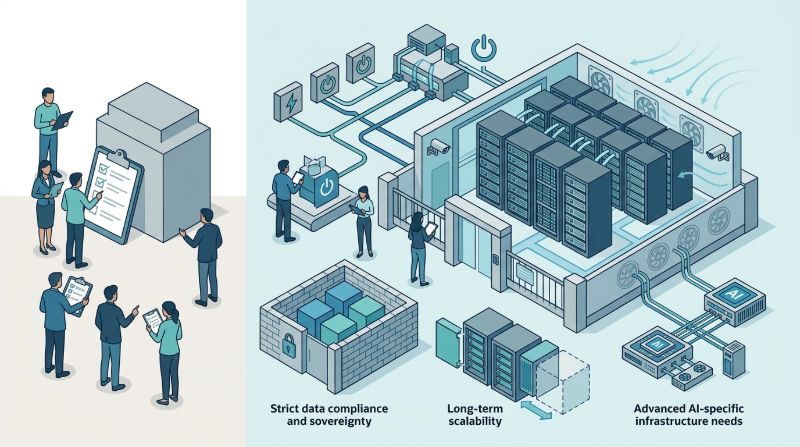
Enterprise infrastructure directors evaluating CoreWeave and Lambda Labs frequently encounter three operational hurdles:
1. Developer Self-Service vs. White-Glove Enterprise SRE
Developer clouds expect customer engineering teams to act as their own data center operations staff. When an InfiniBand optical transceiver degrades, an NCCL link drops, or a PCIe bus throws an Xid error, developer platforms often rely on community Discord forums or ticket-based queues with multi-day resolution times. OneSource Cloud provides white-glove managed infrastructure: dedicated SRE teams proactively monitor node telemetry, manage driver patching, optimize Slurm and Kubernetes fabrics, and hot-swap failing hardware within guaranteed SLA windows.
2. Shared Pod Virtualization vs. Physical Bare Metal
While CoreWeave specializes in Kubernetes-native infrastructure, many of its instances share top-of-rack networking switches and storage fabrics across heterogeneous tenants. Lambda Labs frequently suffers from regional capacity fragmentation and spot preemption. In contrast, OneSource Cloud provisions physically isolated, single-tenant bare-metal clusters where every CPU core, PCIe Gen5 lane, and GPU memory channel is dedicated exclusively to one organization.
3. Mathematical Model: Cluster Preemption Risk and Training Interruption Cost
In developer-centric shared clouds, sudden spot preemption or multi-tenant network pauses trigger cascade failures across distributed training runs. We model the financial loss \(L_{ext{failure}}\) of an un-checkpointed distributed job interruption across \(N\) nodes:
\[ L_{ext{failure}} = \left( T_{ext{lost}} + T_{ext{restart}} ight) \cdot \left( N \cdot C_{ext{node\_hr}} ight) + C_{ext{engineering}} \]
Where:
- \(T_{ext{lost}}\) is the unrecoverable compute time elapsed since the last valid checkpoint snapshot.
- \(T_{ext{restart}}\) is the cluster re-hydration, container restart, and NCCL initialization delay (often 30 to 90 minutes across large clusters).
- \(C_{ext{node\_hr}}\) is the effective hourly cost per 8-GPU node.
- \(C_{ext{engineering}}\) is the labor cost of SRE and ML engineers troubleshooting failed training checkpoints.
Across a 64-GPU cluster, a single mid-run network drop or instance preemption wastes between $8,000 and $25,000 in unrecoverable compute and engineering time. OneSource Cloud eliminates this risk by provisioning dedicated, non-preemptible physical clusters with 99.99% hardware availability SLAs.
Head-to-Head Comparison: OneSource Cloud vs. CoreWeave vs. Lambda Labs
The following technical matrix compares the operational profiles of the three leading specialized GPU cloud providers:
| Operational Criteria | OneSource Cloud (Enterprise) | CoreWeave | Lambda Labs |
|---|---|---|---|
| Core Customer Focus | Regulated Mid-Market & Enterprise AI | AI Scale-ups & Cloud-Native Tech | AI Researchers, Students & Devs |
| Tenancy Model | Dedicated Physical Bare Metal | Shared & Reserved Kubernetes Pods | Shared Instances & Spot Nodes |
| Managed Support Tier | 24/7 Dedicated White-Glove SRE | Platform Support Tier | Developer / Community Forums |
| Interconnect Fabric | 3.2 Tbps Non-Blocking RoCE / InfiniBand | 3.2 Tbps InfiniBand Quantum-2 | Up to 3.2 Tbps (Region dependent) |
| Data Egress Fees | $0.00 / GB (Zero Egress) | $0.00 / GB (In-network) | $0.00 / GB (Basic bandwidth) |
| Healthcare Compliance | Signed HIPAA BAA Standard | Custom Enterprise Negotiation | No Standard BAA |
| Primary Facility Hub | Tier III/IV Dallas Flagship Campus | Distributed US & European Sites | Select Regional Co-location Sites |
| Pricing Predictability | 100% Flat Monthly / Annual Reserved | Reserved Contracts / Hourly Rates | Hourly On-Demand / Reserved |
Cluster Reliability and Node Health Diagnostic Script
To verify the physical stability of dedicated GPU hardware versus shared cloud instances, infrastructure teams can run the following automated node health diagnostic utility:
// Automated GPU cluster node health and PCIe link diagnostic utility
// Detects link retraining, bus degradation, and thermal throttling
#!/usr/bin/env python3
import subprocess
import sys
import json
def audit_cluster_node_health():
    cmd = [
        "nvidia-smi",
        "--query-gpu=index,pci.bus_id,pci.link.gen.current,pci.link.width.current,temperature.gpu,ecc.errors.uncorrected.volatile.total",
        "--format=csv,noheader,nounits"
    ]
    try:
        output = subprocess.check_output(cmd, text=True)
    except Exception as e:
        print(f"Failed to query NVIDIA driver: {e}", file=sys.stderr)
        return False
    lines = [line.strip() for line in output.strip().split("\n") if line.strip()]
    healthy = True
    print("==================================================")
    print("Cluster Hardware Health & PCIe Bus Audit")
    print("Target Environment: OneSource Cloud Dedicated Node")
    print("==================================================")
    for line in lines:
        parts = [p.strip() for p in line.split(",")]
        gpu_id, bus_id, gen, width, temp, ecc = parts[0], parts[1], parts[2], parts[3], float(parts[4]), int(parts[5])
        status = "HEALTHY"
        // Verify PCIe Gen5 x16 link width
        if gen != "5" or width != "16":
            status = "DEGRADED_PCIE"
            healthy = False
        if temp > 80.0:
            status = "THERMAL_WARNING"
            healthy = False
        if ecc > 0:
            status = "UNCORRECTED_ECC"
            healthy = False
        print(f"GPU {gpu_id} [{bus_id}]: Gen={gen} x{width} | Temp={temp:.0f}C | ECC={ecc} | [{status}]")
    print("==================================================")
    print(f"Overall Node Health: {'PASS - PRODUCTION READY' if healthy else 'FAIL - HARDWARE ATTENTION NEEDED'}")
    return healthy
if __name__ == "__main__":
    audit_cluster_node_health()
When running on OneSource Cloud dedicated infrastructure, nodes consistently operate with zero uncorrected ECC memory faults and full PCIe Gen5 x16 line rates, ensuring uncompromised distributed training stability.
When to Choose OneSource Cloud Over Developer Clouds
Enterprise teams should migrate to OneSource Cloud when their workloads outgrow developer-focused platforms:
- Need for Dedicated White-Glove Operations: Your ML team wants to focus entirely on model architectures, prompt engineering, and evaluation benchmarks—not debugging InfiniBand fabrics, Lustre metadata servers, or Slurm daemon errors.
- Strict Healthcare or Financial Compliance: Your models process sensitive clinical records, financial transactions, or intellectual property requiring signed BAAs, SOC 2 Type II audit reports, and single-tenant physical isolation.
- Zero Egress Surcharges: You need to transfer large datasets and checkpoints without worrying about unpredictable network egress billing.
- Predictable Budget Governance: You require fixed monthly billing with clear long-term commitments rather than volatile hourly spot pricing.
Frequently Asked Questions
How does OneSource Cloud differ from CoreWeave?
While CoreWeave provides Kubernetes-based shared and reserved cloud instances, OneSource Cloud specializes in single-tenant physical bare metal with fully managed 24/7 SRE operations, tailored specifically for enterprises that require dedicated hardware isolation, signed BAAs, and predictable flat-rate monthly economics.
Why do enterprises choose OneSource Cloud over Lambda Labs?
Lambda Labs is primarily an on-demand developer platform for researchers and individual developers, frequently experiencing GPU availability shortages and limited enterprise support. OneSource Cloud provides guaranteed, reserved NVIDIA HGX H100 and H200 clusters backed by enterprise SLAs, dedicated SRE support, and robust compliance controls.
Does OneSource Cloud support both Kubernetes and Slurm scheduling?
Yes. OneSource Cloud provides turn-key, pre-configured environments for both native Kubernetes (with Volcano/Kueue orchestration) and high-performance Slurm cluster management, configured specifically for your team's workflow requirements.
Can we migrate existing models and containers from CoreWeave or Lambda Labs?
Yes. Because OneSource Cloud supports standard OCI-compliant container runtimes and NVIDIA CUDA software stacks, any Docker or Singularity container running on CoreWeave or Lambda Labs can be deployed to OneSource Cloud with zero code modifications.
Related Articles
Recommended Reading
-
How Paged Attention Manages Inference KV Cache
-
Google Cloud GPU Pricing: What Enterprise AI Teams Should Evaluate Before Provisioning
-
Paperspace Pricing 2026: GPU Cost Breakdown
-
AI Infrastructure Costs: Controlling Enterprise GPU Spending
-
CoreWeave Enterprise GPU Cloud: Evaluation for AI Teams
-
CoreWeave vs Lambda Labs: GPU Cloud Provider Comparison
-
AWS GPU Pricing: Instance Types, Cost Structure & Alternatives Guide
-
CoreWeave Alternatives: Compare GPU Clouds
latest articles
-
Which GPU Quote Terms Break at Renewal: Price and Capacity Fixes
-
Biotech GPU Computing Requirements: Genomics and Drug Discovery
-
Training Network Encryption: Requirements and Throughput Costs
-
GPU Depreciation Schedule and Monthly Cost at 3, 5, and 6 Years
-
Inference vs Training Storage Requirements for AI Clusters
-
GB200 NVL72 Rack Power Requirements for Facility Planning
-
How to Verify Data-Center GPU Firmware Measurement and Security
-
Why GPUs Stall on NFS During Training: Diagnosis and Fixes
-
GPU Driver and Firmware Pairing Without Deployment Delays
-
Measuring CUDA Graph Impact on LLM Inference Response Times