
Centralized vs Decentralized AI Infrastructure for Teams
Quick Verdict: Centralize the plant when standards, idle GPUs, and audit evidence matter more than a unit’s desire to own a rack. Decentralize when a unit has a unique data plane, a unique SLO, and the staff to run the cluster. Most enterprises keep one catalog plus a few exceptions.
Centralized AI infrastructure is a shared GPU plant and access catalog run by one platform function, while decentralized AI infrastructure is capacity owned and operated by individual business units. The fork is ownership and standards, not whether Kubernetes is involved.
This page is for heads of AI and CIOs who are past “we need GPUs” and are arguing who may buy them. It is not a tenant-isolation verification guide and not a two-layer quota explainer. Isolation still matters in both models. Someone still has to pay for idle HBM in both models.
What do you gain and lose on each side?
| Dimension | Centralized plant | Decentralized plants |
|---|---|---|
| Utilization | Easier to fill nights and weekends | Each unit holds spare “just in case” |
| Speed to first GPU | Fast if the catalog is good; slow if it is a ticket queue | Fast for the owning unit; slow for everyone else |
| Standards | One image, one identity, one evidence pack | Five stacks and five audit stories |
| Blast radius | A platform outage hits many products | A local outage stays local, until they borrow you |
| Best fit | Many teams, similar jobs, scarce specialists | A unit with unique data or a unique regulator |
Centralization fails as a slogan when the catalog is slower than a credit card. Units will buy shadow clouds and tell you at QBR. Decentralization fails as a slogan when every unit pages the same three NVIDIA-savvy people who officially work elsewhere. Count those people before you celebrate autonomy.
When should a business unit keep its own cluster?
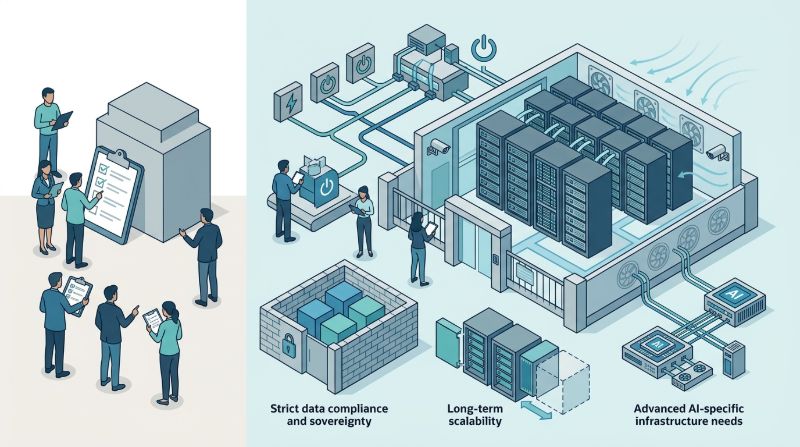
Keep a local cluster when the data cannot move, the SLO cannot share a failure domain, or the unit already staffs the fabric. Factory, trading, and some clinical teams look like this. They still owe the center a minimum: identity, logging sinks, and an offboarding checklist the CISO can read.
Serving Decision Matrix: Enterprise LLM Inference Infrastructure
| Serving Infrastructure Model | Compute & Memory Contention | P99 Tail Latency Predictability | Multi-GPU Tensor Parallelism Support | Optimal Enterprise Workload Fit |
|---|---|---|---|---|
| Shared Multi-Tenant Model APIs | Multi-tenant shared workers; opaque resource pooling | Severe tail latency jitter during peak concurrency spikes | Black-box; no control over model parallelism or KV cache sizing | Low-volume prototyping or asynchronous background tasks |
| Virtualized Cloud GPU Instances | Hypervisor vGPU slices subject to CPU/PCIe interrupts | Moderate jitter caused by neighboring tenant network bursts | High inter-node latency limits multi-GPU tensor scaling (TP=4/TP=8) | General internal apps with modest throughput requirements |
| OneSource Dedicated Private GPUs | Dedicated bare-metal hardware with 100% VRAM & compute reservation | Deterministic microsecond P99 response times under peak load | Dedicated RoCE v2 RDMA fabric enables low-latency TP=4/TP=8 scaling | Mission-critical, low-latency, regulated enterprise production serving |
They should not keep a local cluster because a director wants a photo of “our GPUs.” That is a utilization problem wearing a badge. Private AI infrastructure can be centralized or dedicated to one unit. The contract should say which, in writing.
When should the center own the default path?
The center should own the default when jobs are similar (fine-tunes, RAG-adjacent batch, ordinary serving) and specialists are scarce. One catalog, one reclaim policy, and one evidence pack beat six half-built plants. Orchestration is how the center stays a product instead of a ticket queue.
Give units a burst lane and a published exception process. A center with no exceptions becomes a black market. A center with only exceptions is not a center.
What does a hybrid look like without becoming chaos?
One exclusive U.S. plant, including capacity in Texas / Richardson, as the default. A small number of unit plants for data or SLO exceptions. The same identity and the same minimum storage controls. OnePlus Platform, OneSource Cloud’s AI orchestration platform, can present unit workspaces on the shared plant so “decentralized product teams” do not require decentralized hardware.
Managed operations can sit on the shared plant while a unit with a real exception still runs its own hall. Healthcare and fintech units often need the exception conversation. They do not automatically need a second vendor relationship. Write the test: unique data plane, unique SLO, unique staff. If two of three are missing, stay on the catalog.
FAQ
Is a centralized plant the same as a single-tenant cloud?
No. Single-tenant describes who else is on the hardware. Centralized describes which internal org owns the catalog. You can centralize on exclusive GPUs or decentralize across three exclusive halls. Do not mix the words in an architecture review.
How do we stop units from buying shadow GPU cloud?
Beat them on time-to-first-GPU and on the paperwork they will need later. If the center takes a month and a card takes a day, you have your answer. Publish both numbers.
Who pays for idle capacity in a centralized model?
The center can hold a buffer and show it back to units, or units can buy reserved slices. What fails is a buffer nobody admits exists and a shortage everybody blames on “the platform.”
Can we decentralize training and centralize serving?
Yes, if the weight handoff is a real artifact pipeline. Many orgs do the reverse and regret it: serving multiplies products, and a serving outage is customer-facing. Put the shared SLO on the shared plant unless a unit can staff it.
Why deploy latency-sensitive LLM inference on OneSource private GPUs?
OneSource private GPU infrastructure delivers 100% dedicated bare-metal compute and VRAM, completely isolated from cross-tenant contention. This eliminates hypervisor scheduling jitter and shared-network packet collisions, ensuring deterministic P99 tail latency, sustained token throughput, and optimal tensor parallel scaling for production enterprise LLM serving.
Summary
Centralize the default plant and catalog. Decentralize only when data, SLO, and staff are truly local. Hybrid is a short exception list, not a seventh ideology. Idle GPUs and audit evidence do not care about org charts unless you assign them an owner.
If you want one exclusive U.S. catalog with unit workspaces, start from OneSource Cloud private AI infrastructure and OnePlus orchestration rather than funding a rack per director.
Related Articles
Recommended Reading
-
Google Cloud GPU Pricing: What Enterprise AI Teams Should Evaluate Before Provisioning
-
Paperspace Pricing 2026: GPU Cost Breakdown
-
CoreWeave Enterprise GPU Cloud: Evaluation for AI Teams
-
AI Infrastructure Costs: Controlling Enterprise GPU Spending
-
CoreWeave vs Lambda Labs: GPU Cloud Provider Comparison
latest articles
-
Self-Service GPU Access for Enterprise AI Teams
-
When to Run an LLM Privately for Production Inference
-
AI IaaS vs AI PaaS for GPU Workloads
-
NVIDIA DGX Cloud vs Hyperscalers for Training
-
MLOps vs ML Engineering Roles for AI Teams
-
How to Shed Load During LLM Inference Spikes
-
Draft Model Selection for Speculative Decoding
-
Router Models vs Rules-Based Routing for Inference
-
Do Checkpoint Downloads Count as Data Egress?
-
Why You Shouldn't Checkpoint to Local NVMe