
AI Infrastructure Retirement and Refresh Planning Guide
AI infrastructure retirement and refresh planning is the lifecycle discipline that determines when accelerator hardware should be decommissioned and replaced, based on reliability, efficiency, and generational economics rather than failure alone. Most organizations plan acquisition carefully and retirement not at all, letting clusters run until something breaks badly enough to force a decision. The result is a crisis-shaped refresh: urgent procurement, compressed evaluation, and workload disruption, executed at the worst possible negotiating moment.
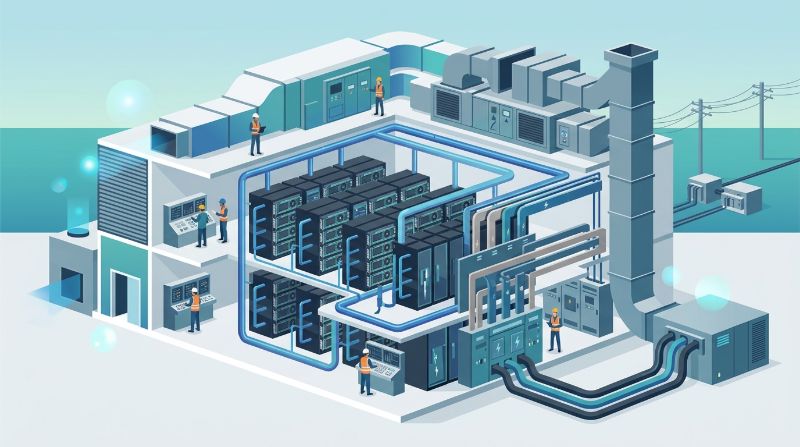
Treating retirement as a scheduled engineering activity instead flips the economics. Refresh decisions made deliberately, against tracked metrics and a written runbook, cost less, risk less, and can be timed to generational hardware transitions instead of chasing them.
Why Accelerators Age Faster Than Servers
Three clocks run against GPU fleets simultaneously, and none of them is the traditional server depreciation schedule. The reliability clock: sustained near-thermal-limit operation ages accelerators faster than general-purpose compute, with memory error rates and fan and power subsystem failures climbing in the fleet's later years. The efficiency clock: each hardware generation improves performance per watt substantially, so an aging fleet's electricity and cooling bill quietly grows relative to its useful output. The economics clock: per-GPU capability advances so quickly that a three-year-old cluster can cost more per unit of training throughput than a new one, even while fully depreciated on the books.
The practical consequence is that GPU refresh cycles run closer to three or four years than the five-to-seven-year rhythms familiar from CPU server fleets, and organizations that plan on accounting schedules alone operate their oldest, least efficient hardware at exactly the moment its failure rate peaks.
Refresh Trigger Metrics Worth Tracking
A refresh decision deserves evidence, and four metric families supply it. None requires exotic tooling; all of them require that someone looks at them on a schedule:
| Trigger Family | Representative Metrics | Refresh Signal |
|---|---|---|
| Reliability | Memory ECC rates, node failure frequency, RMA turnaround | Failure rate doubling versus the fleet's stable-year baseline |
| Efficiency | Performance per watt on a reference workload | New-generation hardware delivering 2x or better per-watt gains |
| Economics | Cost per training run versus new-generation quotes | Continued operation costing more per unit of work than replacement |
| Capability | Memory capacity, interconnect bandwidth versus workload needs | Next-generation models or serving features no longer fitting the cluster |
The capability row deserves emphasis because it is the one finance discussions miss. A cluster can be perfectly healthy and still be retired-worthy the day the organization's model roadmap requires memory capacity or fabric bandwidth the hardware cannot reach.
The Retirement Runbook
When a refresh date is set, execution follows a runbook with five gates. Each gate has an owner and a verifiable exit condition:
The Five Gates
// Retirement runbook gates
1. Workload census    : every job and dataset on the old cluster identified
2. Migration waves    : workloads moved in scheduled batches with parity checks
3. Data sanitization  : cryptographic or physical erasure, attested in writing
4. Decoupling         : access paths, DNS, and integrations formally retired
5. Disposal           : certified recycling, resale, or return per contract
Sanitization Is a Compliance Event
The data sanitization gate is the one regulated industries cannot improvise. Retirement is a compliance event as much as an operational one: model weights, training data, and any residual user data must be erased with attestation before hardware leaves organizational control, and the attestation must name the devices, the method, and the operator. Clusters under managed contracts should verify that this obligation is written into the provider's exit terms rather than assumed.
Timing Refresh Around Generation Transitions
Because capability jumps between GPU generations are large, refresh timing interacts with the hardware roadmap. Buying three months before a new generation launches means operating mid-tier hardware for the entire next cycle; buying immediately after launch means paying early-availability prices and waiting in queue. The pragmatic pattern is to track announced generations, plan refresh dates against them, and split large fleets into staggered waves so that no single transition moves the whole platform at once. Staggered refresh also preserves a live cluster for migration targets, which is what keeps retirement from ever requiring downtime.
Contract Terms That Make Refresh Cheaper
Organizations on dedicated infrastructure should negotiate refresh mechanics before they need them. The clauses that matter: defined upgrade windows allowing mid-term moves to new generations with pro-rated credit, migration assistance written into the provider's scope, hardware replacement obligations that cover aging-induced failure without separate charges, and exit provisions that include the attested data sanitization described above. Providers that structure these terms transparently convert refresh from a negotiation into a scheduled service event.
Retirement as Routine
The end state of a mature program is unremarkable, which is the point. Triggers are reviewed quarterly against dashboards; refresh waves appear on the capacity plan a year ahead; the runbook executes without heroics; and finance sees the economics before the purchase order, not after. OneSource Cloud supports this operating model contractually, with defined upgrade rights to new accelerator generations, migration assistance as part of the service scope, and attested data sanitization at exit, so that retirement and refresh remain scheduled engineering activities rather than emergencies.
Related Articles
Recommended Reading
-
How Paged Attention Manages Inference KV Cache
-
Google Cloud GPU Pricing: What Enterprise AI Teams Should Evaluate Before Provisioning
-
Paperspace Pricing 2026: GPU Cost Breakdown
-
AI Infrastructure Costs: Controlling Enterprise GPU Spending
-
CoreWeave Enterprise GPU Cloud: Evaluation for AI Teams
-
CoreWeave vs Lambda Labs vs OneSource Cloud: GPU Provider Decision Guide
-
AWS GPU Pricing: Instance Types, Cost Structure & Alternatives Guide
-
U.S. Data Residency in the Cloud: Requirements, Regulations & Compliance Guide
latest articles
-
NVLink vs InfiniBand: Designing Scale-Up AI Interconnects
-
GPU Commitment Capacity Analysis to Eliminate Idle AI Spend
-
Slurm vs Kubernetes for GPU Cluster Sharing Across ML Teams
-
DGX H100 Rack Power Budgeting: Sizing 40kW to 100kW AI Pods
-
Time to First Token Load Testing on Production LLM Clusters
-
Encrypted GPU Training Environments: Hardware Root of Trust
-
H100 GPU Data Wait Monitoring to Resolve Storage Bottlenecks
-
Expert Parallel Serving Network Design for Low-Latency MoEs
-
VPC Peering Network Design for Dedicated Private AI Clusters
-
Model Parallel Rank Placement for Distributed AI Clusters