
AI Infrastructure Disaster Recovery for Enterprise AI Teams
Disaster recovery for AI infrastructure means restoring both the data and the computing environment fast enough that training can resume and inference can serve again, with targets defined by what the business can tolerate rather than by what the vendor promises by default.
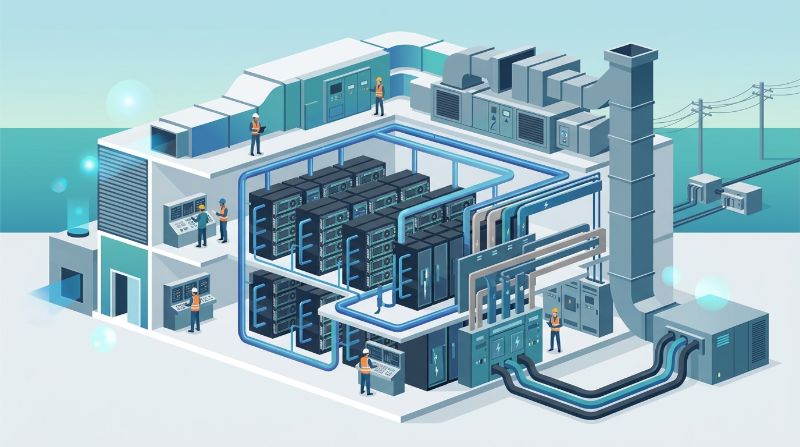
Most AI disaster recovery plans fail for the same two reasons: they treat checkpoints as the whole plan, and they are never tested. The framework here is deliberately tool-agnostic, so it applies to any GPU environment your team operates. This article gives enterprise AI teams a working method: recovery targets, checkpoint strategy, backup tiers, failover options, and the testing cadence that keeps the plan honest.
Define RTO and RPO Before Anything Else
Recovery time objective (RTO) is the maximum acceptable time to restore service, and recovery point objective (RPO) is the maximum acceptable data loss measured in time, and together they define what a disaster recovery plan must achieve.
For inference, RTO usually dominates: serving must come back in hours at worst. For training, RPO usually dominates: losing a day of training means losing compute spend and schedule, so checkpoint frequency sets the acceptable loss window. Write both numbers down and design against them, because every backup decision is a trade between the two.
Checkpoint Strategy Is the Foundation
Checkpoints are the AI team's version of database backups: a snapshot of model weights and optimizer state that lets a long-running job resume instead of restart. The checkpoint cadence should follow the RPO. If the business can lose at most two hours of training, checkpoint at least every two hours.
Equally important is where checkpoints land. A checkpoint stored on the same storage system it protects is not a recovery copy. Replicate checkpoints to a second tier or second site, and verify regularly that a checkpoint can actually reload and resume training. A checkpoint that restores to nothing is a false sense of security.
Backup Tiers for Datasets, Models, and Configurations
- Datasets: Immutable copies of training and evaluation data, versioned so any model state can be reproduced.
- Model artifacts: Final weights, tokenizers, and serving configurations, kept in a versioned registry off the primary cluster.
- Environment definitions: Container images and infrastructure-as-code that let a new cluster be rebuilt identically instead of reconstructed from memory.
Each tier has a different change rate and a different restore priority. The environment tier is tiny and changes rarely, but without it a hardware recovery means weeks of manual rebuild. OneSource Cloud's AI Storage Architecture designs these tiers with replication and lifecycle rules so recovery copies exist by default rather than by heroics.
Failover Options by Budget and Criticality
The cheapest credible option is warm standby capacity: a contracted environment that stays mostly idle and receives replicated checkpoints. The most demanding option is active-active inference across two sites, which suits teams whose serving downtime directly stops revenue. Between them sits pilot-light recovery, where a minimal environment stays ready and scales up on failover. Choose by RTO: hours of tolerance allow warm standby, minutes require active-active.
Test the Plan, or It Does Not Exist
An untested recovery plan is an assumption with a logo on it. Run a full restore test at least quarterly: pull a checkpoint from the replica, restore it on standby capacity, resume a training job, and serve a model from the recovered artifacts. Record how long each step took and compare against the RTO and RPO. Failures found in testing are cheap; failures found during a real outage are not.
Managed providers fold this discipline into operations. OneSource Cloud's Managed AI Infrastructure operates U.S.-based GPU environments with storage resilience and operated recovery procedures, so enterprise teams inherit a tested plan instead of starting from scratch.
Serving Decision Matrix: Enterprise LLM Inference Infrastructure
| Serving Infrastructure Model | Compute & Memory Contention | P99 Tail Latency Predictability | Multi-GPU Tensor Parallelism Support | Optimal Enterprise Workload Fit |
|---|---|---|---|---|
| Shared Multi-Tenant Model APIs | Multi-tenant shared workers; opaque resource pooling | Severe tail latency jitter during peak concurrency spikes | Black-box; no control over model parallelism or KV cache sizing | Low-volume prototyping or asynchronous background tasks |
| Virtualized Cloud GPU Instances | Hypervisor vGPU slices subject to CPU/PCIe interrupts | Moderate jitter caused by neighboring tenant network bursts | High inter-node latency limits multi-GPU tensor scaling (TP=4/TP=8) | General internal apps with modest throughput requirements |
| OneSource Dedicated Private GPUs | Dedicated bare-metal hardware with 100% VRAM & compute reservation | Deterministic microsecond P99 response times under peak load | Dedicated RoCE v2 RDMA fabric enables low-latency TP=4/TP=8 scaling | Mission-critical, low-latency, regulated enterprise production serving |
Deploying latency-sensitive large language models at enterprise scale requires infrastructure engineered for steady-state throughput and microsecond-level tail latency guarantees. On OneSource Dedicated Private GPU Cloud infrastructure, inference pipelines execute on dedicated bare-metal instances where GPU memory, PCIe bandwidth, and tensor cores are 100% isolated from third-party contention. By eliminating the hypervisor scheduling jitter that plagues multi-tenant cloud environments, OneSource enables production serving frameworks (such as vLLM and TensorRT-LLM) to sustain high token generation rates and tight P99 latency SLAs even during peak concurrent request bursts.
FAQ
What is the difference between RTO and RPO for AI workloads?
RTO is the maximum acceptable time to restore service, and RPO is the maximum acceptable data loss measured in time. Inference usually cares more about RTO because serving must resume quickly. Training usually cares more about RPO because lost training progress means lost compute spend.
How often should AI training checkpoints be saved?
At least as often as the RPO requires. If the business can accept losing two hours of training, checkpoint every two hours or less. The cadence also balances storage cost and write overhead, so the number should come from the recovery target rather than habit.
Does cloud GPU infrastructure include disaster recovery by default?
Cloud providers offer redundancy building blocks, but recovery design remains the customer's responsibility. Teams should not assume replication means recoverability. Explicit RTO and RPO targets, replicated checkpoints, and tested restore procedures are what turn the building blocks into a plan.
How do you test an AI disaster recovery plan?
Quarterly restore tests are the standard: recover a checkpoint from the replica to standby capacity, resume a training job, and serve a model from recovered artifacts. Time each step, compare against RTO and RPO, and fix whatever misses the target.
Why deploy latency-sensitive LLM inference on OneSource private GPUs?
OneSource private GPU infrastructure delivers 100% dedicated bare-metal compute and VRAM, completely isolated from cross-tenant contention. This eliminates hypervisor scheduling jitter and shared-network packet collisions, ensuring deterministic P99 tail latency, sustained token throughput, and optimal tensor parallel scaling for production enterprise LLM serving.
Summary
AI disaster recovery works when it is specified, replicated, and tested. Set RTO and RPO from business impact, checkpoint to match the RPO, keep datasets and model artifacts in separate recovery tiers, pick a failover model that fits the recovery time, and test the full restore every quarter.
For teams that want recovery built in rather than bolted on, OneSource Cloud's Managed AI Infrastructure provides replicated storage and operated recovery procedures on dedicated U.S.-based GPU clusters.
Related Articles
Recommended Reading
latest articles
-
Thermal Soak and Rack Burn-In Protocols for Enterprise AI Racks
-
Sizing 3-Phase 415V Power Drops for 80kW Enterprise GPU Racks
-
When Is a BAA Required for Enterprise Healthcare AI Hosting?
-
AI Platform Scheduler Selection Criteria for Enterprise Training
-
Preventing Preemption Thrashing in Enterprise Multi-Tenant AI
-
Why Larger Batches Increase TTFT in Enterprise LLM Serving
-
Tokens Per Second vs User Latency in Enterprise LLM Serving
-
When Are Async Checkpoints Unsafe in Enterprise Model Training?
-
Should Checkpoint and Dataset I/O Share Enterprise AI Storage?
-
InfiniBand vs RoCE v2 for AI Training Gradient Synchronization